Category: Blog

  • Descartes in Italy: To Sell Some Mules

    Descartes in Italy: To Sell Some Mules

    [et_pb_section fb_built=”1″ _builder_version=”4.16″ custom_padding=”26px|||||” global_colors_info=”{}”][et_pb_row _builder_version=”4.16″ background_size=”initial” background_position=”top_left” background_repeat=”repeat” min_height=”5326.3px” global_colors_info=”{}”][et_pb_column type=”4_4″ _builder_version=”4.16″ custom_padding=”|||” global_colors_info=”{}” custom_padding__hover=”|||”][et_pb_text _builder_version=”4.17.1″ background_size=”initial” background_position=”top_left” background_repeat=”repeat” custom_padding=”0px|||||” global_colors_info=”{}”]

    Most of the details of Descartes’ alleged journey to Italy are known only from Baillet’s biography, La vie de Monsieur Des-Cartes (1691, vol. I, pp. 117-28). According to Baillet, Descartes left Paris in September 1623 for a one-and-a-half year trip to Italy, and returned via Lyon in May 1625. Baillet has much to say about where Descartes went and whom he met, but his account could never be confirmed by independent evidence. This is why several historians of philosophy have given it almost no importance, while others believe that this long journey must have marked the philosopher’s life and career. That Descartes actually went to Italy is clearly indicated by his letters; what is sorely lacking, however, is definite information about the places he visited or the people he met. All we know from the correspondence is that he did not like the climate or the food in Italy. [*]

    I have recently found evidence that casts light on Descartes’ journey to Italy. It compels us to reduce his journey to only six weeks, from the end of March 1625, when he left Paris, to the beginning of May 1625, when he arrived in Lyon. The historical documents found are an inventory after his death and a deed drawn up before a notary in Lyon, both dating from 1625. The crucial passages of the first document [A] are discussed below, and the full text of the second document [B] is given in the appendix. We will first discuss what motivated this travel project; then what the new documents tell us about it; finally we will try to reconstruct the way Baillet misinterpreted the journey, by briefly recalling what Descartes certainly did not do in Italy.[1]

    According to Baillet, the reason for Descartes’ trip to Italy was the death, in Turin, of a relative who had accompanied the French expeditionary army to Piedmont as Commissaire général des vivres, a very important position.[2] This relative would be a certain M. Sain, husband of Descartes’ godmother, who died in early March 1623 (Vie, I, 118). Baillet then summarizes a letter from Descartes to his elder brother Pierre, dated March 21, 1623, according to which he is going to settle the affairs of the deceased and see if he can acquire his office; all the necessary arrangements for the trip would have been made and he would like to leave for Turin the next day (AT I, 3). However, according to Baillet, instead of leaving the next day, Descartes would have gone to Poitou to sell some goods, would have returned to Paris in the summer and would have begun his journey in September.

    In reality, Baillet’s account cannot be entirely correct. First of all, he is mistaken about the identity of the relative, for Jean Sain, the husband of Descartes’ godmother, had already died in 1619. The relative referred to here is René Sain, first cousin of Descartes’ mother, Jeanne Brochard. The second error is that René Sain did not die in 1623, but in 1625.[3]  

    René Sain, sieur de Rochefort, married Léonore de Féal (or Foyal) in 1603. The couple had seven children, the oldest of whom was also named René, like his father. One of the daughters, Françoise, married Guillaume du Tronchay, sieur de Martigny, in February 1624; Descartes knew him personally, and he rendered some services to Descartes in Paris from late 1639. In March 1622, René, the father, was appointed Conseiller secretaire du Roy et Grand Audiencier de France, a position from which he resigned in September 1624,[4] presumably in preparation for his appointment as “superintendent of supplies to the camps and armies, munitions and stores of France” in the impending French military campaign against the Spanish-backed Republic of Genoa. The French army led by the Duke of Lesdiguières, Constable of France, arrived in Turin in February 1625. René Sain died in Turin on March 3, 1625 — the date of his death, the place and his office as “superintendent of supplies” are mentioned in the inventory after death drawn up at the request of his widow in Paris on April 3, 1625.

    Descartes is mentioned in an addition to the inventory :

    Du vendredy vingt troise jour de may audict an [1625] fut faict et inventorié ce qui s’ensuict. Ensuyvent les papiers et enseignemens qui estoient où ledict deffunct Sr Sain est decede et qui onct esté raportéz à ladicte présente. […] Item trois pièces attachées ensemble. La première est une promesse du Sr de Thorigny dactée du xiiie avril mvic vingt cinq contenant ledict Sr debvoir au Sr Descartes la somme de sept cens vingt livres pour la vente des mullectz que appartenoient audict deffunct Sr Sain. La seconde est une lettre de change de ladicte somme tirée par ledict Sr de Thorigny le mesme jour et an sur le Sr Vuidaud l’Aisné, marchand à Lion, pour paier ladicte somme audict Sr Descartes, et la troise pièce est un acte de protestation de ladicte lettre de change faicte par ledict Sr Descartes audict Vuidaud pardevant André Dechuyes, notaire audict Lion, en dacte du septe jour de may audict an mvic vingt cinq, partant reffus faict par ledict Vuidaud de paier ladicte somme.

    On Friday 23 May 1625 the following was inventoried: Below follow the papers and instructions that were at the place where the late Mr Sain died and which have been reported to his widow who is present. […] Item three pieces attached together. The first one is a promise of Mr de Thorigny dated April 13, 1625, acknowledging his debt to Mr Descartes of 720 pounds for the sale of mules which belonged to the deceased Mr Sain. The second is a bill of exchange of the aforementioned sum drawn by Mr de Thorigny the same day and year on Mr Vuidaud the Elder, merchant in Lyon,[5] to pay the said sum to Mr Descartes. And the third piece is an act of protest of the aforementioned bill of exchange by Mr Descartes to Vuidaud before André Dechuyes, notary in Lyon,[6] dated May 7, 1625, because of the refusal of Mr Vuidaud to pay the aforementioned sum.[7]

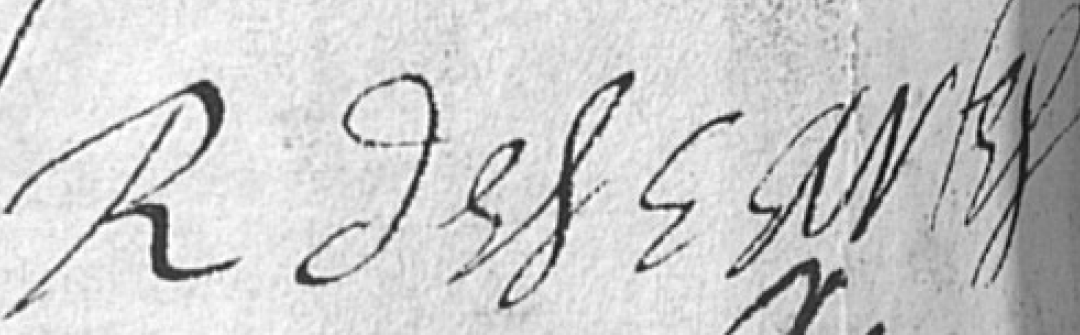
    The three documents discussed in this text concern a transaction between Thorigny and Descartes, the former buying from the latter several mules that had belonged to the deceased René Sain for 720 livres. Descartes received an acknowledgement of debt and a bill of exchange to be cashed at a certain Vidaud in Lyon. Called upon to honor it, Vidaud refused to pay, hence the act of protest drawn up before the notary, a usual procedure in such cases. The fact that these documents are mentioned in the inventory shows that the debt of 720 livres (a considerable sum) had not yet been settled. The minutes of the act of protest, bearing Descartes’ signature, have been preserved (see below, Appendix B), which proves that the “Sieur Descartes” mentioned in the inventory is indeed René Descartes. In addition, this document reveals Vidaud’s first name — Jean —, Thorigny’s title of nobility — Count — and the place where the transaction took place — in the camp of the French army in siege of the fortified town of Gavi (about 50 km north of Genoa). Jacques Goyon de Matignon (1599–1626), Count of Thorigny, served in the expeditionary army of the Duke of Lesdiguières as “maître de camp” of a light cavalry regiment.[8] The act of protest thus confirms a remark of the old biography of Pierre Borel (1656) according to which Descartes would have visited the seat of Gavi.[9] Baillet knows this biography (Vie, I, 126) and suggests that at Gavi Descartes met Pierre de Boissat (1603–1662; Vie, I, 145), who made his career in the army but was also a man of letters, and in 1634 one of the first members of the French Academy. He actually participated in the campaign against Genoa.[10] He seems to have become an admirer of Descartes’ philosophy, but there is no evidence that the two men met under the walls of Gavi.

    Sain’s children were less than 25 years old, so they were still minors: this is why the widow Léonore de Féal had to look for a reliable person “to put the affairs of the deceased in order” (AT I, 3). A cousin with no ties and no fixed position, who also had experience of travel and was familiar with military life, was therefore an ideal candidate for this task. Descartes wrote to his brother that all the necessary arrangements had been made, for example a power of attorney allowing Descartes to act on behalf of the heirs – unfortunately no such document was found in the archives of the notary who drew up the inventory. Of course, Descartes would be well rewarded for his efforts, and he could also let his brother know that “if he did not return richer, at least he would return more capable” (AT I, 3).

    The main question is why Baillet believes that Sain died in 1623. We must first note that Baillet is right in asserting that Sain died in Turin at the beginning of March: he must have found this information in Descartes’ letter to his brother. The date of this letter is, according to Baillet, March 21, 1623; but if the day and month are probably correct, the year is certainly not: it must be 1625, since René Sain died on March 3, 1625. This error is probably explained by the fact that Descartes dated his letter “de Paris, ce 3 mars” without specifying the year. From his errors about the identity of “M. Sain” and the date of René Sain’s death, Baillet had to improvise: he conjectured that Descartes had returned to France via Lyon in May 1625, and then assumed that Descartes had gone directly to Poitou to inform M. Sain’s widow, i.e., Jean Sain’s widow, when in fact he had to go first to Paris to see René Sain’s widow, Léonore de Féal. Since the only other documents he had were contracts of sale from June and July 1623, drawn up in Poitiers and Châtellerault (Vie, I, 116), Baillet imagined what might have happened in this gap in Descartes’ biography. From Borel, he knows that Descartes was at the siege of Gavi (April 1625); from Descartes’ papers, he also knows that he had promised to make a pilgrimage to Loreto (cf. AT X, 217-8). Wondering what Descartes might have done in Italy between 1623 and 1625, he had him attend the ceremony of the Wedding of the Sea in Venice (May 1624) and the opening of the Holy Year in Rome in December 1624. Moreover, he assumes that Descartes met powerful princes and cardinals, men of science and philosophers, and he does not hesitate to give their names. Finally, by dating Descartes’ letter to his brother to 1623, he can claim that Descartes was a spectator of the Rosicrucian frenzy, but Didier Kahn has already shown that all that Baillet says about it is unreliable, and that given the plague epidemic, it is unlikely that Descartes was in Paris in August 1623.[11] We can add that for the same reasons it is unlikely that Descartes was in Paris between February and April 1623.

    In sum, Descartes’ Italian journey was very short. He left Paris on 22 March 1625, as he told his brother. Once arrived in Turin, he discovered that the army had left the city, and was laying siege to Gavi. Descartes went to Gavi, made the necessary arrangements, including the sale of some mules on 13 April, and he did not acquire the post of army intendant. He returned presumably to Turin, and then headed back through the Alps to Lyon, where his presence is attested on 7 May. Descartes was less than a month on Italian soil, and did not visit Venice, Loreto or Rome. Nor did he, as Baillet wants us also to believe, make a such thorough study of human nature during his travels in Italy, that he saw no need to continue his journey to Sicily and Spain (Vie, I, 122)! What we are left with is a gap in Descartes’ biography from July 1623 to March 1625. It seems likely, though, that Descartes was present at the wedding of his brother Pierre in Elven in September 1624.


    Appendix B. Notary deed signed by René Descartes, Lyon, 7 May 1625. Archives départementales du Rhône et de la métropole de Lyon, 3 E 3985, fo. 167r–v (André Dechuyes, notary public).

    Photographs of the manuscript are found below.

    Du Mercredy vij May 1625.           Protest Descartes, de Touriny, Vidaud.

    En presence etc. <rayé : noble> René Descartes, escuyer Sr du Perron, a exhibé et presenté au Sr Jean Vidaud l’aisné, marchand demeurant à Lyon, une lettre ou mandat à luy adressante, faicte et signée par Monsieur Le Comte de Thorigny, dattee au Camp devant Gavy le treiziesme Apvril dernier, de la somme de sept centz vingt livres tournoiz payable audict Sr Descartes à lettre veue, et a sommé ledict Sr Vidaud d’accepter ladicte lettre et luy payer ladicte somme qu’il offre recepvoir et faire aquict vallable parlant à la personne dudict Sr Vidaud treuvé audict Lyon, en son domicille, lequel a faict responce, que par faute de provision il ne la peut payer. C’est pourquoy ledict Sr Descartes a protesté de tous despens, dommages et interestz faictz et à faire, et de prendre ladicte somme à change et rechange en ceste dicte ville de Lyon pour tel lieu et pris que bon luy semblera aux frais et despens dudict Sr Comte, et autres qu’il appartiendra, dont a esté faict le present acte audict Lyon, lieu susdict, le septiesme jour du mois de May avant midy mil six centz vingt cinq, presentz Charles Girard, clerc, et Charles Dechuyes, ciergier dudict Lyon, tesmoins requis qui ont signé avec ledict Sr Descartes, non ledict Sr Vidaud de ce requis et sommé.

    C. Dechuyes, présent               R. Des Cartes

    Girard, présent


    [*] The text published here is the English version of a short note published in the Bulletin cartésien LI (2022), and can be downloaded at the website of Centro dipartimentale di Studi su Descartes “Ettore Lojacono”, University of Salento.

    [1] As I did not visit the Archives nationales de France in Paris nor the Archives départementales du Rhône et de la métropole de Lyon myself, I am very grateful for the help I received from several people. I would like to thank the active contributors of the project Familles Parisiennes (see note 7), Laurence Abensur-Hazan, généalogiste, for finding and photographing the marriage contract mentioned in note 3, Béatrice Beaucourt, genealogist et paleographer, for decyphering passages that were very hard to read in the Lyon notary deed, and finally to the staff of the Arch. dép. du Rhône for their determination to retrieve that particular notary deed.

    [2] An army intendant is a civilian who accompanies a campaigning army and is in charge of all army supplies, and all administrative, juridical, and financial aspects of the army’s operations and movements (cf. cf. Dictionnaire de l’Ancien Régime, ed. Lucien Bély, 2nd ed. (Paris 2005), 471–2).

    [3] Apparently in corroboration of Baillet, Aubert de la Chesnaye Desbois maintains that René Sain died in Turin in 1623 (Dictionnaire de la noblesse, vol. 14, 428–32). Jean Mesnard however points out that René Sain personally signed the marriage contract of his daughter Françoise in February 1624; the other document cited by Mesnard to show that René Sain was still alive in 1630 concerns Sain’s eldest son, equally called René (Mesnard, ‘Entre Pascal et Descartes: Jacques Habert de Saint-Léonard,’ Travaux de linguistique et de littérature 13 (1975), 111).

    [4] Abraham Tessereau, L’Histoire chronologique de la Grande Chancellerie de France, vol. 1 (Paris 1710), pp. 336, 348.

    [5] The Vidaud (or Vuidaud) family was a family of merchants and bankers in Lyon. The merchant in question is presumably Jean Vidaud the Elder (L’Aisné), who is mentioned in a marriage contract (Lyon, 1614) as an uncle of the groom, also called Jean Vidaud. See the online genealogy of the various branches of the Vidaud family by Gérard Bachelier, URL: http://g.bachelier.free.fr/vidaud.htm (last consulted 29 October 2021).

    [6] André Dechuyes, notary public in Lyon between 1602 and 1639.

    [7] Paris, Arch. nat., Minutier central, ET/LXXXVIII/127 (Nicolas Robinot, public notary). The minutes are digitesed in the context of the project Familles Parisiennes (see www.famillesparisiennes.org). The text quoted is available online, URL: https://nl.geneanet.org/archives/registres/view/43486 (vue 82); last consulted 29 October 2021. Photographs of the manuscript are published in the notice mentioned in footnote [*].

    [8] Louis Videl, Histoire de la vie du Connestable de Lesdiguières (Paris 1638), pp. 412, 422, 435.

    [9] Pierre Borel, Vitae Renati Cartesii compendium (Paris 1656), p. 4.

    [10] Cf. Videl, Vie de Lesdiguières, 410, 421, 464; Pierre de Boissat, Opera seu operum fragmenta (Lyon? 1649?), 40–50 (mention of the presence of François Goyon de Matignon (1607–1675), younger brother of the Count of Thorigny, 43); Baillet’s refers to Nicolas Chorier, De Petri Boessatii … vita (Grenoble 1680), pp. 136, 140, where the author discusses Boissat’s preference for Descartes’ philosophy.

    [11] Didier Kahn, ‘The Rosicrucian Hoax in France (1623–24)’, in William R. Newman and Anthony Grafton (eds.), Secrets of Nature: Astrology and Alchemy in Early Modern Europe (Cambridge MA: MIT Press, 2001), 235–344.

    [/et_pb_text][et_pb_image src=”https://decodingdescartes.nl/wp-content/uploads/2022/04/Arch.-dep.-du-Rhone-3-E-3985-fo.-167r.png” title_text=”Arch. dép. du Rhône, 3 E 3985, fo. 167r” _builder_version=”4.17.1″ _module_preset=”default” custom_margin=”|166px||||” global_colors_info=”{}”][/et_pb_image][et_pb_image src=”https://decodingdescartes.nl/wp-content/uploads/2022/04/Arch.-dep.-du-Rhone-3-E-3985-fo.-167v.png” title_text=”Arch. dép. du Rhône, 3 E 3985, fo. 167v” _builder_version=”4.17.1″ _module_preset=”default” global_colors_info=”{}”][/et_pb_image][/et_pb_column][/et_pb_row][/et_pb_section]

  • Food for Thought

    Han van Ruler © 2021

    Over the last half a century or so, René Descartes (1596-1650) has gradually lost his one-time status as a philosopher whose work merits serious and continued scholarly interest. The NWO-funded research project Decoding Descartes, launched at Erasmus School of Philosophy (ESPhil), Erasmus University Rotterdam, in January 2020, is meant to change this, and to contribute to a reappraisal of the philosopher and his works. Amongst other things, Decoding Descartes will result in a new, critical edition of Descartes’ vast corres­pon­dence to be published with Oxford University Press. Descartes’ letters and the letters others addressed to him are a gold mine in themselves for the study of seventeenth-century European intellectual history, but besides the work on the correspondence, Decoding Descartes also has a substantive part on Descartes’ philosophy. This part of the project aims not only to rehabilitate the philosopher and to address the many misconceptions that have tinged his reputation, but also to explain why it is as important as ever to assign to Descartes a central role in philosophical history as well as in present philosophical, scientific and public debate. What follows is an early taster for this theoretical part of our project.

    The Need for a New Descartes

    More and more historians and philosophers are presently becoming aware that the caricature, twentieth-century image of René Descartes no longer holds. In both the analytical and continental traditions, academics are starting to acknowledge that Descartes was not the metaphysical thinker primarily concerned with offering theories about God and the soul, but presented himself primarily as a scientist and as a philosopher of the body, drawing attention to human emotional life as well as to the need for getting to grips with psychosomatic phenomena in new, scientific ways. As a consequence, more and more scholars are starting to notice the historical inaccuracy of the concept of ‘Cartesian dualism’.

    There is, however, still a lot to be done. In a recent article on ‘The embodied Descartes’, Barnaby Hutchins, Christoffer Basse and Charles Wolfe have argued a new “reading of Descartes” is emerging especially “from recent scholarship on L’homme.”[1] In fact, the article itself occurs in an edited volume of studies on L’homme that marks the renewed interest in this work. The Traité de l’homme (or ‘Treatise on Man’) is an early treatise by Descartes on human physiology. The book was never published during the philosopher’s lifetime, but already caused a stir back in the 1660s, when Descartes’ star was rising ever faster with the rediscovery of L’homme, and it became clear that the author of the Meditations and the Principia had already developed a complete biological description of human beings that could serve as a background for his work on the emotions and other themes of psychosomatic interest. 

    What we are thus witnessing today is a something of a repetition on a global scale of what once occurred on the streets of Leiden and Paris, when people started to realise what Descartes had really been on about. I have previously had the privilege of writing about this ‘other Descartes’ in my introductory chapter to the Oxford Handbook of Descartes and Cartesianism in 2019.[2] The story of the alternative Descartes goes somewhat like this: contrary to the textbook image we are all acquainted with, the historical Descartes was not at all the metaphysical thinker a superficial reading of his most popular works may seem to suggest. Neither was he the ‘dualist’ that many philosophers after him used — and still use — as a straw man in order to define their own — often in fact rather ‘Cartesian’ — positions. In contrast to this cliché-Descartes, the historical Descartes was a philosophically inclined natural scientist, whose contribution to science lay not so much in formulating natural laws (which, incidentally, he also did – in fact, he invented the notion of such laws), but in philosophically paving the way for science. Descartes showed the way to scientific investigation by indicating how one could think about man as a biological being without making any use of the notion of the ‘soul’ and how one could think about natural processes without using concepts such as ‘substance’, ‘form’ or ‘substantial form’.

    At present, this is a message that has yet to land in the world of philosophy and science. A large number of authors in the fields of neurophysiology, cognition theory and philosophy, continue to accuse Descartes of having somehow introduced the distinction of body and soul — a distinction Descartes could never have introduced, if only for the fact that it is a distinction that has no doubt been made in every culture since human beings started to express themselves in language. Nevertheless, claiming to adjust an erroneous attempt in Descartes to link the body to the mind, philosophers as well as scientists have had a tendency to go about doing exactly the kind of things Descartes had already been doing himself almost four centuries ago.

    Decoding Descartes aims to rehabilitate Descartes by providing a solid historical reconstruction of the context in which he operated. What is new in this research project, is that we will try to uncover Descartes’ own philosophical motivations by interpreting his thinking from the perspective of his intellectual background: why did he actually say and do what he did? On the basis of an answer to this question, we aim to gain a better insight into the nature of the intellectual turn that Descartes brought about, and to indicate its continued relevance to philosophical and scientific thinking.

    Critical Rehabilitation

    Probably the most widespread misconception about Descartes stems from the Kantian divide between ‘rationalism’ and ‘empiricism’ — a point to which we will return below. A close second in spreading persistent misconceptions about Descartes — at least within the analytic tradition in Western philosophy — is Gilbert Ryle’s famous critique of Descartes in The Concept of Mind (1949). Ryle’s view still lives on in the work of countless others through such persistent memes as ‘The Cartesian Myth of the Ghost in the Machine’ and the unhelpful idea that Descartes committed what Ryle called a ‘category mistake’.

    Ryle’s own big mistake was that, by arguing that the human mind should not itself be reified into an object of enquiry, he was doing exactly what the real Descartes himself had been trying to get across to his own, seventeenth-century, audience. Acknowledging the fact that Descartes was facing this same problem, we should equally acknowledge that Descartes was not just prefiguring Gilbert Ryle on this account, but must also count as the precursor of Hume, Kant, Sartre, Wittgenstein and many other philosophers besides.

    For a while I thought I was the only one who saw things quite this way, but last year Rodney Ramdas, a master’s student of ours at ESPhil, pointed out to me that Ian Hacking had already come to the same conclusion and that there was in fact a whole series of feminist thinkers (including Sara Heinämaa, recently a keynote at the annual Dutch OZSW conference), who have been claiming similar things for decades. It was in this way that I discovered the work of Lilly Alanen, who already in 1989 pointed out that, under the influence of Ryle, analytic philosophy collectively suffered from the “Myth of the Cartesian Myth.”[3] That Myth, however, is still everywhere present today. In 2005, Ian Hacking also thought he was more or less alone in questioning the Myth. Not without a sense of drama, Hacking accordingly described his position as an iconoclasm:

    My iconoclasm is to suggest that Descartes’s final response to the princess Elisabeth was to say much the same thing as Ryle, [only] in the barely worked out idioms of an earlier age.[4]

    So much for Ryle and analytical philosophy. Misconceptions about Descartes are not limited to analytic philosophy, however. Since 1994, I have myself time and again repeated that the Portuguese-American neuroscientist Antonio Damasio is himself a Cartesian, despite the fact that he viewed everything he did to be a correction of Descartes’s Error — the unfortunate title of his 1994 book. When Damasio came up with the idea in 2010 that human self-experience was not just about emotions, but that human consciousness might also be important for understanding humans, he wrote the following:

    Conscious reflection and planning of action introduce new possibilities in the governance of life over and above automated homeostasis, in a remarkable novelty of physiology. Conscious reflection can even question and modulate automated homeostasis and decide on an optional range of homeostasis at a higher level than needed for survival and more consistently conducive to well-being. The imagined, dreamed-of, anticipated well-being has become an active motivator of human action. Socio-cultural homeostasis was added on as a new functional layer of life management, but biological homeostasis remained.[5]

    Freely translated: in addition to their primary reactions, human beings also have the opportunity to think about these reactions and to adjust them. These words were formulated in 2010, but what Damasio has to say here is in part a repetition of ancient Greek moral philosophical insights — and partly pure Descartes. More importantly, it is a blatant acceptance of what Descartes is always being accused of: dualism.

    It is not that I do not like Damasio’s work; I love it, just as I love the work of Daniel Dennett, whose life — by his own admission — has more or less been dedicated to the question of overcoming Descartes.[6] In Dennett, too, we see Descartes returning at crucial steps of the argument, for example in Dennett’s defence of free will, in which the two core aspects of ‘decision making’ and ‘training’ are in fact a reiteration of what Descartes had already put forward in his Passions de l’Âme of 1649, even if Dennett interprets the position of his opponents as ‘Cartesian’, and even if Descartes himself did not refer to tennis, but more generally to the regulation of one’s emotions.[7] And in Dennett, too, we thus encounter an unmistakable manifestation of ‘dualism’ in the ‘distribution’ of the various types of ‘work done’ by the agent.

    Cognitive science does not fare much better. Francisco Varela, Evan Thompson and Eleanor Rosch have hurled philosophical swear words such as ‘representation’, ‘Ego-Self’ and ‘Cartesian Anxiety’ at Descartes — and not at just Descartes, but at all of his supposed followers in the West.[8] Meanwhile, as an alternative, they came up with ideas about the embodied self, about why we do not coincide with our brains (again: dualism!), and with new biological explanations of consciousness that form a complex of positions each of which has its historical background in Descartes’ Dioptrics (1637), Meditations (1641) and Passions of the Soul (1649).

    What is behind all of these misconceptions? The problem, every time, is that philosophers, neuroscientists, and cognitive theorists alike keep confronting Descartes with the metaphysical questions that Descartes himself was trying to avoid and banish from natural-philosophical investigation. This is also reflected in the continental reception of Descartes, in which the latter’s philosophy is read as something of a variation on Aristotle. Descartes may have come up with a new philosophy, but, according to this view, it was still a philosophy not much different from the philosophy that went before, in as much as it still depended on an ‘essentialist’ ontology. Change would come only with Spinoza and Leibniz, who, at least according to present-day Critical Theory, came forward with the idea of ​​a new, “modal” type of metaphysics; a metaphysics that might still inspire us.

    To see what is wrong with this view, there is no need to enter into a sophisticated analysis of Spinoza’s or Leibniz’s views on substances and modes. What suffices, is to take a closer look at what actually drove Descartes.

    Lasting relevance

    Gilbert Ryle’s critique on Descartes would be better applied to Spinoza and Leibniz. The Verdinglichung, or reification, of the subject that Ryle wrongly attributed to Descartes can indeed be found in Leibniz, who, in the wake of Descartes, tried to revive the idea of ​​individual substances by introducing the notion of ​​metaphysical ‘monads’. Spinoza reified all of reality in one go: everything in fact made up a single ‘substance’. Both Leibniz and Spinoza had good meta-philosophical reasons for reintroducing such metaphysical concepts. Spinoza benefitted from the reification of the whole of reality by playing his Protestant tune of spiritual salvation on the metaphysical instrument of a complete necessitarianism, thus being able to show that even in the age of science, one might still find security in God’s hands. Leibniz made use of his own particular type of reification by allowing all things to take their own course, thereby absolving God of any responsibility for evil — but also portraying him as a somewhat naive logician-annex-juggler in the design of the universe.

    Why Descartes distinguished himself and makes a difference here, is because he no longer made use of the concept of the mind in order to make metaphysical claims, just as he no longer found it meaningful to attach qualities to things that are derived only from mentally experiencing them. What he did, in other words, was to stop looking for metaphysical entities in reality. Descartes was already convinced, early on in his life, that our sense-experience brings with it a host of intellectual delusions. This was not because he was an incorrigible ‘rationalist’, or a bad scientist who did not like to make observations or devise experiments (both of which he did a lot), but because he was aware that in trying to understand the world of physics and ourselves, we need to be warned against making our everyday experience of ordinary things intrude into the explanations of things natural. If we would keep judging knowledge on the basis of our common sense experience of objects and events, we would never achieve any scientific progress, but would remain stuck with classical types of philosophical description, in particular the Aristotelian categorisation of things.

    Descartes accordingly does not fit into the rigid Kantian dichotomy between rationalism and empiricism — but then again, no one does. The real Descartes was in fact concerned with criticising arm-chair types of philosophising. He only doubted the reliability of the senses because he knew that in our efforts to try and understand the world as well as ourselves in scientific ways, we should leave behind our common-sense conceptions of things, as well as the way in which we think and speak about them on the basis of our everyday experience.

    Descartes knew it had traditionally been the great mistake of philosophy to make our common experience the leading factor in the description of nature. As a result, pre-Cartesian philosophy had never arrived at any insight in the fields of physics, chemistry or biology, but had remained stuck in classical, especially Aristotelian, descriptions of reality. If we would continue only to have an eye for individual ‘things’, their ‘inner substance’ and their ‘outer properties’, it was highly unlikely we would ever get beyond the kind of subject-predicate descriptions of the world by which we link qualities to substances and attribute to the objects of everyday experience a metaphysical essence. Classical thought had made us spin around in philosophical circles and prevented natural philosophy from explaining anything worthwhile about the processes that elude our common sense world-outlook.

    Descartes also knew that the problem ran deep. Throughout his life, he insisted that we are epistemically biased by our childhood and by the distorted image we have of reality on the basis of our language use. In an effort to find a method that went beyond the common-sense interpretation of things, he showed science the way: reality was no longer to be divided into individual ‘things’, nor should science any longer be seen as the attempt to attribute causal responsibilities among these separate agents. Of course, we do this all the time in our daily lives, but according to Descartes (who, again, was 350 years ahead of Antonio Damasio in this respect) we do this only because it is useful in order for us to survive. We have an innate cognitive survival mechanism that is functional in that it allows us to recognise things very quickly, but real ‘knowledge’ of these very same things is something else entirely.

    Science calls for a method that bypasses our direct sensory experience, but we have a hard time getting rid of the influence of our subjective involvement in nature. Our daily dealings with the world are strongly integrated with our conceptions of the what the world is made of; conceptions that are enshrined in the grammar of our language, in our logic and our philosophy. It was important, according to Descartes, that we reflect on this at least once in our lives, and learn to distinguish our 1st-person experience of the world from the 3rd-person description of what is going on. That profound lesson about our epistemological situation as human beings, first presented in Descartes’ Meditations, is still of utmost importance for understanding both the world we live in and ourselves.

    Descartes Today

    Descartes’ contribution to physics was short-lived, as his attempt to interpret nature mechanistically was soon to be supplanted by Newton’s far more successful way of limiting oneself as a scientist to a mathematical description of dynamic processes. But although Descartes’ way of doing science soon became obsolete, this did not make his theory of knowledge any less relevant. In fact, Descartes’ philosophical development can be reconstructed as a continuous attempt to learn more about both the world and ourselves from the perspective that reality as we know it presents itself in our daily experience in ways that only very indirectly relate to the processes we try to describe and understand by scientific means – which is a truth in many ways still relevant today.

    Descartes devoted an entire philosophical life to the proper demarcation of the subjective and the objective perspectives. Over the next two years, the project Decoding Descartes will continue to try and formulate how present-day paradoxes in philosophy and science link up with what Descartes put on the philosophical agenda almost four centuries ago — not only in order to come to a reinterpretation and reappraisal of the work of the least understood philosopher in the Western tradition, but also in order to offer a new, twenty-first-century, appraisal of its continued relevance.


    [1] Barnaby R. Hutchins, Christoffer Basse Eriksen, and Charles T. Wolfe, ‘The Embodied Descartes: Contemporary

    Readings of L’Homme’, in: Delphine Antoine-Mahut and Stephen Gaukroger (eds), Descartes’ Treatise on Man and its Reception, Studies in the History and Philosophy of Science 43, Cham: Springer, 2016, pp. 287-304 (quotation from p. 278).

    [2] Han van Ruler, ‘Philosopher Defying the Philosophers: Descartes’s Life and Works’, in: Steven Nadler, Tad M. Schmaltz and Delphine Antoine-Mahut (eds), The Oxford Handbook of Descartes and Cartesianism, Chapter 1, Oxford: Oxford University Press, pp. 3-24.

    [3] Lilly Alanen, ‘Descartes’s Dualism and the Philosophy of Mind’, Revue de Métaphysique et de Morale 94 (1989-3), pp. 391-413 (quotation from p. 392). Alanen may historically count as the ‘first mover’ in the philosophical revision of our understanding of Descartes, but it should be added that she was heavily inspired by Descartes-scholars in the earlier, twentieth-century French tradition, just as I was myself.

    [4] Ian Hacking, ‘The Cartesian Vision Fulfilled: Analogue Bodies and Digital Minds’, Interdisciplinary Science Reviews 30 (2005-2), pp. 153-166 (quotation from p. 159). In his article, Hacking refers to a young American who once put him on the trail of Descartes’ Principia and to the work of Heleen Rozemond as positions that bear some resemblance to what he himself was trying to say vis-à-vis Ryle.

    [5] Antonio Damasio, Self Comes to Mind: Constructing the Conscious Brain, London: Vintage Books, 2012, pp. 292-293.

    [6] Daniel C. Dennett, Consciousness Explained, Borton: Little Brown, 1991, Preface and Chapter 2: ‘Explaining Consciousness’.

    [7] Dennett introduces the example of a tennis player in his discussion of the famous Libet experiment; cf. Daniel C. Dennett, Freedom Evolves, New York: Penguin, 2003, pp. 238-242. Towards the end of the first part of The Passions of the Soul, Descartes likewise introduced the possibility of training oneself for developing reaction patterns that refuse to be come about on the basis of conscious volitions. Cf. Les Passions de l’âme I 46-50, AT XI, pp. 363-370.

    [8] Francisco J. Varela, Evan Thompson and Eleanor Rosch, The Embodied Mind: Cognitive Science and Human Experience, Cambridge, Mass: MIT Press, 1993. See for instance pp. 134ff, 65ff and 140ff for the use of the respective swear words.